

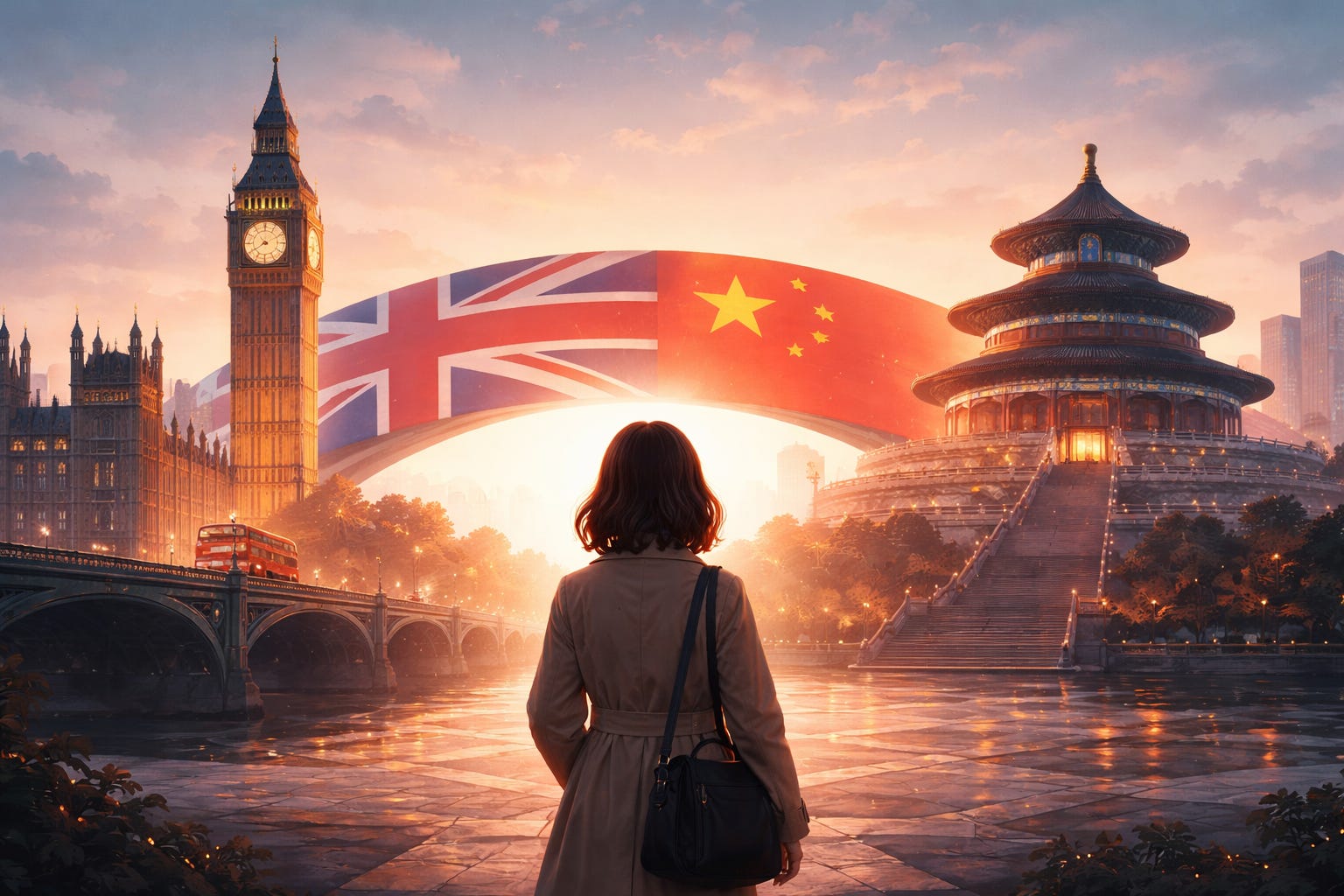
Last summer marked the end of a six year chapter: working for Western think tanks as a China programme specialist. I studied international affairs at a policy school in the US and built my career around one question: how to narrow the gap between China and the world, without flattening either side into caricature. My CV is full of organisations with “Asia” or “China” in their names.
A few months have passed since I left my last role at Asia House in London. This is my attempt to share what I overheard on that lonely yet rewarding path, working at the intersection of China and policy.
Often, I found myself caught between competing interests. Often, I had to navigate prejudice from peers and, at times, colleagues. Often, as the only Chinese person in the room, I envied the solidarity I saw in adjacent worlds of journalism, law, finance and etc.
So what DID I overhear?
Security risks
The UK has been repeatedly unsettled by China related espionage allegations since the previous administration. From the “two Christophers” cases to the latest reporting involving the spouse of a Labour MP, it is hardly surprising that anyone with China based ties or China facing work is quickly pulled into what can feel like “spy territory”, against a backdrop of heightened national security scrutiny.
A friend once suggested an analogy with insider trading, not because the offences are the same, but because both turn on how societies police sensitive information and proximity. Imagine if you have a partner working in finance and sharing an offhand view about the markets over dinner, have they crossed a legal line, or simply talked about their day-to-day? Similarly, working close to foreign governments, let alone the “enemy” ones, could feel like walking a even tighter rope given the high stakes. You can be as meticulous as you want about what you say, but trust can remain very fragile. I have crossed paths professionally with people later described as suspected spies, without any awareness at the time. What I remember most is not recklessness, but thier restraint and carefulness. It brings to mind a darker logic familiar from Xi’s anti-corruption campaign: in any system, few are spotless under a microscope. The difference is who gets examined, when, and to what end.
To make this less abstract, I’ve worked in foreign think tanks inside China (RIP Carnegie-Tsinghua Center), where scrutiny feels immediate and personal. Local staff at foreign organisations are always on the radar and sometimes would be “invited to tea”, a euphemism for an interview with public security. What stayed with me was the speed with which surveillance could become intervention. After a brief phone call about an incoming delegation, I received a follow up call asking, in detail, what I was working on and who I would meet. It is not uncommont that local staff feels caught between official pressure and a basic professional duty to protect the organisation’s privacy.
Yet suspicion also runs in the other direction. More than once, I waited outside foreign embassies in Beijing with the Chinese driver while my expat colleagues went in, a small ritual that made the hierarchy of trust visible. Learning to move between these systems with empathy, discretion, and respect for real constraints became one of the most valuable lessons one was able to learn from working inside foreign policy institutions.
Identity and positioning
When I moved to London in early 2023, I was struck by how limited the city’s “China capacity” felt compared with Washington. At the risk of minimising my credentials, I often became the “China expert” by default, simply because of how I look. The label could be useful, but it also narrowed me, turning a whole career into a single identity tag.
At a sponsored event by a Chinese company at the think tank I was working at, an attendee questioned whether I, the only Chinese employee, influenced the event’s “friendly” take on China, even though I hadn’t been involved into running the programme. Another time, when a journalist’s attendance was rejected due to venue overcapacity, they asked to speak to me specifically — “the Chinese staff” — assuming my nationality had something to do with this decision to turn down their attendance. Moments like that reminded me that my expertise and identity are intertwined with professional perception as I often felt like a bridge between cultures and an outsider within them.
Another more extreme incident was a Westminster special adviser once joked to my face that I had been sent by Beijing as a “honey trap”. Even though the claim was clearly untrue, I still felt at the moment shaken with uncertainty what I could say that would not make things worse. There remains a strain of paranoia in parts of the China rhetoric abroad, shaped by history and politics that reinforce each other. I feel for the people whose genuine efforts to build relationships and support constructive engagement are recast as something malign.
China through the lens of DC and London
Living in San Francisco at the moment, I have been struck by the mood of Chinamaxxing and “you met me at a very Chinese time in my life”. People pass around books like Dan Wang’s Breakneck, trade jokes about Trump admiring Xi’s authority, and scroll TikToks that turn China’s infrastructure into a kind of abundance spectacle.
London feels different. Perhaps it’s the city’s colonial legacy that still lends certain circles an old-boy-club air, a faint nostalgia for its historic connection to China through its dominance of Hong Kong. I’ve met retired UK business executives who fondly recall the bicycle-filled streets of 1990s Beijing yet show little curiosity about the electric vehicles that have replaced them. Still, London brings together a wide range of voices, though fewer with recent on-the-ground experience in the political and policy circle. In Jeremy Goldkorn’s Very British China problems, he argues that the UK is stuck in a weird position. It wants to stay on good terms with the United States and needs trade and investment after Brexit. That leaves Britain dependent on China, which now holds far more leverage. Chinese voices have made it plain that the UK no longer carries the weight it once did and can be replaced in China’s wider strategy.
What matters
I often get messages from students asking for advice to pursue a career in China policy studies. Here is what I thought might be helpful if I were to do this again.
Stay current
Pick two or three reliable newsletters and stick with them. Add sector specific reads that match your interests: energy, climate, finance, tech.Learn how policy is made
Surprisingly few people, even in the field, can explain it clearly. Learn how bills move through committees, appropriations, and conference stages in your interested jurisdiction. Learn how agencies draft and finalise regulations. Then practise explaining those processes out loud.Master your Specilisation
“Proximity to power deludes some into thinking they wield it.” Frank Underwood was right. Being in the room is not the same as being heard, but you can still learn from everything. Pair China expertise with another skillset: data, energy, climate, tech, transport. Find a topic that keeps you up at night and make it yours.
What has your experience been like working in policy. Which place shaped your view of China most. Any moments that changed how you see the whole China watching world. I would love to hear them.
[I would like to thank my two Substack spirit animals, afra and Yaling Jiang for being the star examples to encourage me to start writing. And to the mentors who guided me through deep waters: Jan Berris, Paul Haenle, Dan Russell, Michael Hart, and Geoffrey Jackson, thank you for showing me what diplomacy looks like in practice.]
Such unique perspective of being in the middle! Appreciate the advice at the end too.
Thanks for the article! Quite interesting point on DC vs. London, I had a feeling that in London's tech sector (as you mentioned in SF), there are many people interested in the current trend of China. It is interesting to learn that in business / policy field, it is quite different.